
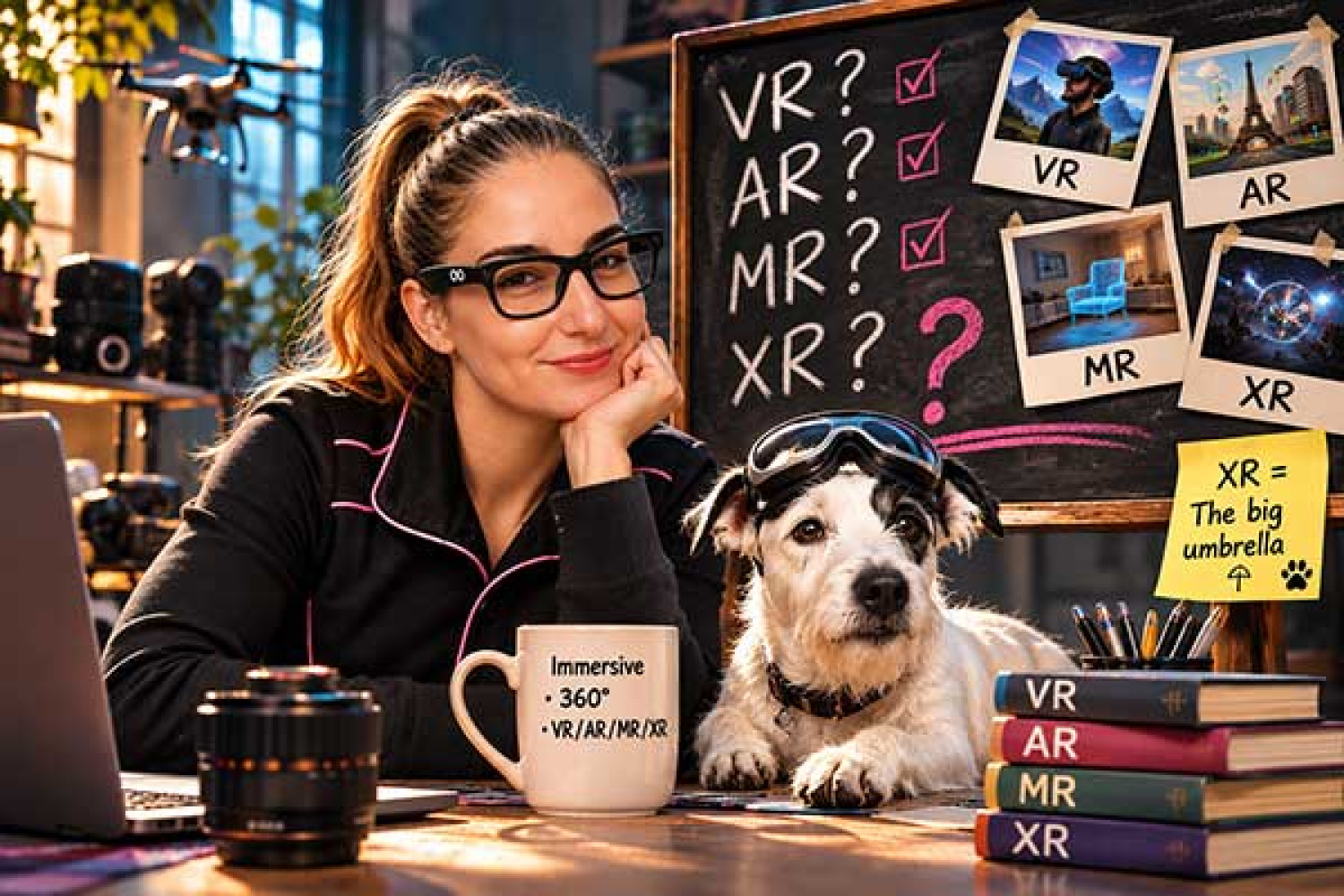
A survival guide to immersive acronyms
Virtual Reality, Augmented Reality, Mixed Reality and Extended Reality. Four technologies, a suspicious number of acronyms, and an industry that appears to invent new terminology every time someone makes a better pair of glasses.
If you’ve ever wondered what all these letters mean, why people wear computers on their faces, or whether the Metaverse is still alive, you’re in the right place.
Welcome to the Future. Again.
Once upon a time, reality was quite simple.
You woke up, drank your coffee, went to work, complained about the weather, and occasionally wondered what you were doing with your life.
Then technology came along and decided that one reality wasn’t enough.
First, we had VR. Then AR. Then MR. Then XR.
Then someone announced the Metaverse, everyone got very excited, and suddenly companies were selling virtual land that you couldn’t actually stand on.
And just when we thought we finally understood what was happening, someone walked into the room and said:
“Actually, we call it Spatial Computing now.”
Excuse me?
At this rate, by the time you finish reading this article, someone will probably have invented YR, ZR and a headset that can read your thoughts and order pizza.
But what does all of this mean?
Do you need expensive glasses? Can you touch things? Will you meet aliens? And most importantly, can you still see where you’ve left your coffee?
Let’s find out.
VR AR MR XR Explained: Four Letters, Several Realities, and One Confused Brain
First, What Exactly Is Reality?
Excellent question.
Unfortunately, philosophers have spent thousands of years discussing this, and we have neither the time nor the budget to solve it here.
For the purposes of this article, let’s assume reality is the place where your electricity bill arrives, your dog needs walking, and your washing machine breaks down just after the warranty expires.
Now imagine technology can replace this reality, add things to it, or mix it with another one.
Congratulations. You have understood approximately 80% of the XR industry.
The remaining 20% consists of acronyms, charging cables and people arguing about definitions.
Let’s start with the basics.
Immersion: When Your Brain Forgets Where You Are
Have you ever watched a film and become so involved that you forgot you were sitting on a sofa?
Or read a book so good that you missed your train stop?
That’s immersion.
Your attention becomes absorbed by another world.
Now imagine putting on a headset and finding yourself standing on top of a skyscraper.
You look down.
There is a very long drop.
Your knees suddenly become nervous.
You KNOW you’re in your living room.
You KNOW the building doesn’t exist.
You KNOW the carpet is underneath your feet.
But your brain says:
“Absolutely not. We’re going to die.”
This feeling of actually being somewhere else is called presence.
And it’s one of the fascinating things about Virtual Reality.
Researchers distinguish immersion — what the technology does to surround you — from presence, the psychological feeling of being there.
In other words, your eyes say you’re on a mountain, your brain starts to believe it, and your cat wonders why you’re screaming in the middle of the living room.
The Fourth Wall Has Gone Missing
In theatre and cinema, there’s something called the fourth wall.
It’s the invisible barrier between the actors and the audience.
The actors pretend you’re not there, and you pretend not to notice that the living room they’re standing in has only three walls.
Everyone is happy.
But in 360° filming, there’s a small problem.
The camera sees EVERYTHING.
There is no convenient space behind it for the crew.
The director is visible. The cameraman is visible. The lighting equipment is visible. Even the person eating a sandwich in the corner is visible.
So while traditional filmmakers ask:
“How do we create a believable world?”
360° filmmakers ask:
“Where the hell do we hide everybody?”
And believe me, after years of professional 360° production, sometimes this is the hardest part of the entire shoot.
Interactivity: Can I Touch It?
Now imagine you’re standing in a virtual kitchen.
There’s a virtual refrigerator.
You walk over and open it.
Inside is a virtual cake.
Can you eat it?
No.
Can you pick it up?
Maybe.
Can you throw it at someone?
Depends on the software.
This is interactivity.
It means the virtual world responds to what you do.
You might use hand controllers, your fingers, your eyes, your voice or even your body movements.
You can grab objects, open doors, paint pictures, play games, operate virtual machinery or accidentally knock over your real coffee table while trying to fight a digital monster.
That last one happens in the real world, unfortunately.
But here’s something important.
Not every immersive experience is interactive.
Sometimes you simply watch and look around.
A 360° documentary, for example, can transport you into an extraordinary environment without allowing you to change what’s happening.
Just like real life at a family dinner.
You’re there, you can look around, but you cannot necessarily control what your uncle says.
VR — Virtual Reality
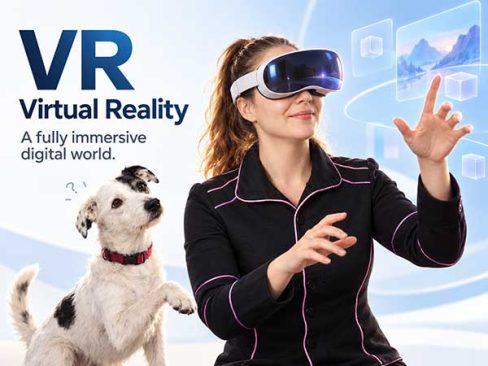
Put a Television on Your Face and Go Somewhere Else
VR stands for Virtual Reality.
In simple terms, you put on a headset, and the real world is replaced by another one.
Your living room disappears.
Suddenly, you’re inside a spaceship.
Or on a beach in Thailand.
Or visiting a factory in Germany.
Or sitting beside a hospital bed in a documentary.
And you didn’t even have to go through airport security.
That’s the beauty of VR.
You can experience another place without physically travelling there.
Sometimes that environment is created entirely using computers.
Sometimes it’s filmed in the real world using special 360° cameras.
Sometimes it’s a combination of both.
Wait, Is 360° Video Actually VR?
Yes, it can be a form of VR experience.
But it’s not exactly the same as walking around in a computer-generated world.
Imagine you’re sitting inside a train.
With a 360° video, you can turn your head and look in any direction.
You can admire the landscape, examine the seats, or spend the entire experience watching the passenger behind you picking their nose.
Your choice.
But normally, you cannot get up and walk to another carriage.
With an interactive six-degrees-of-freedom (6DoF) VR experience, you may be able to move around, depending on how the experience was created.
These are different kinds of VR, each with their own creative possibilities.
And despite what some people in the technology industry might tell you, more interactivity does not automatically mean a better experience.
Sometimes being present inside a powerful story is enough.
Behind the scenes, professional tools such as Mistika VR and professional 360° post-production help transform complex multi-camera recordings into seamless immersive experiences.
What Is VR Actually Used For?
Well, apart from pretending to be a medieval knight while your family watches you wave your arms around?
Quite a lot.
VR is used for professional training, education, industrial simulations, design reviews, cultural experiences, artistic installations, documentaries, entertainment and more.
A company might use VR to show customers a factory on the other side of the world.
A museum might let visitors experience a historical environment.
A trainee might practise a dangerous procedure in a simulation before attempting it in real life.
And a filmmaker might use VR to place the audience inside an emotional story rather than simply showing it from the outside.
The headset is the tool.
The experience is what matters.
Curious about immersive filmmaking? Discover how BREATHE — an immersive VR documentary uses 360° storytelling to place the viewer inside a deeply personal experience.
AR — Augmented Reality
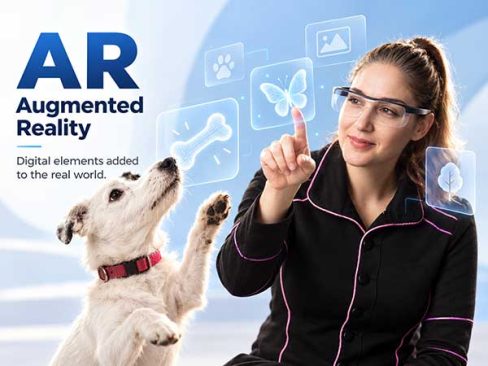
The Real World, but Someone Has Added a Dinosaur
AR stands for Augmented Reality.
The idea is quite simple.
You still see the real world, but digital objects or information are added to it.
Imagine sitting in your kitchen, looking through your phone, and suddenly seeing a dinosaur standing next to your refrigerator.
Your kitchen is still there.
Your refrigerator is still there.
The dinosaur is not.
Hopefully.
That’s AR.
Remember Pokémon GO?
That’s probably one of the best-known examples of the technology reaching a mass audience.
People were walking through parks, streets and shopping centres looking for imaginary creatures on their phones.
For once, millions of people were getting exercise because of something on a screen.
Technology is full of surprises.
But Why Would Anyone Need This?
Excellent question.
Imagine buying a new sofa.
Instead of measuring your room, arguing with your partner about whether it will fit, ordering it, waiting three weeks and discovering it’s too big…
You point your phone at your living room and see a digital version of the sofa in place.
You can check whether it fits before spending your money.
Or imagine visiting a museum.
You point your tablet at an ancient Roman ruin.
Suddenly you see what the building might have looked like 2,000 years ago.
Or you point it at a painting and watch a character step out of the frame.
AR can add useful information, education, entertainment and context to things we already see.
And no, AR doesn’t necessarily have to be interactive.
Sometimes the information simply appears.
Think of AR as reality with extra toppings.
Like pizza.
Except you can’t eat the toppings.
MR — Mixed Reality
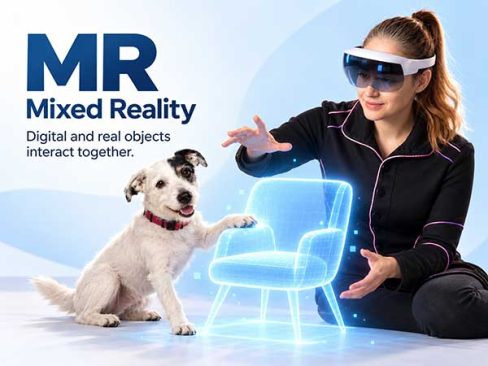
Your Sofa Is Real. The Dragon Sitting on It Isn’t.
Now things become slightly more complicated.
MR stands for Mixed Reality.
And despite what some marketing departments might suggest, it isn’t a brand-new invention.
Researchers were already discussing the relationship between real and virtual environments in the 1990s.
Today, Mixed Reality is often used to describe experiences where digital objects are integrated into the physical space around you.
Let’s return to our kitchen.
In basic AR, a dinosaur appears on your phone screen.
Very impressive.
But perhaps it doesn’t really understand where your kitchen table is.
In a more advanced MR experience, the system can recognise surfaces and understand something about the room.
Now the dinosaur can walk behind your sofa.
Jump onto your table.
Hide behind your refrigerator.
And perhaps stare at your dog.
Your cat, of course, still sees nothing.
But you can see a digital creature behaving as if it belongs in your physical environment.
That’s the interesting part of Mixed Reality.
The real world and the digital world are no longer simply displayed together.
They can interact spatially.
So What’s the Difference Between AR and MR?
Well…
Imagine asking five XR specialists this question.
You may receive seven different answers.
And at least one invitation to a conference.
The boundaries overlap, and Mixed Reality has also been used historically as a broad term for combinations of real and virtual environments.
But for everyday understanding:
AR adds digital things to reality.
MR makes digital things behave as though they share your physical space.
Not a perfect scientific distinction, but a useful place to start.
XR — Extended Reality
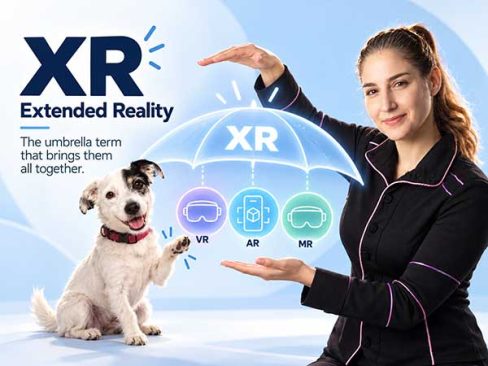
When Nobody Can Agree, Invent an Umbrella Term
By now, we’ve learned about VR, AR and MR.
But apparently three acronyms weren’t enough.
Enter XR.
XR stands for Extended Reality.
And the good news is that this one is actually quite simple.
It’s an umbrella term for the whole family.
VR, AR and MR all belong under XR.
Imagine you have three children.
One likes to live in imaginary worlds.
One likes to put digital dinosaurs in the kitchen.
And one wants the dinosaurs to interact with the furniture.
Instead of shouting all three names every time dinner is ready, you simply shout:
“XR! DINNER!”
That’s essentially what the industry did.
XR is useful when you’re talking about immersive technologies in general.
And it’s not just an invented marketing expression: the international OpenXR standard uses XR as a term encompassing VR, AR and MR.
So yes, sometimes the acronym soup is genuinely useful.
Spatial Computing
The Computer Has Escaped from the Desk
For decades, computers lived in boxes.
You sat in front of a screen.
You moved a mouse.
You clicked on little rectangles.
Then someone said:
“What if the computer wasn’t limited to a screen?”
And that brings us to Spatial Computing.
Instead of organising everything on a flat monitor, digital windows and objects can appear around you in three-dimensional space.
Imagine checking your email on a virtual screen floating above your kitchen table.
Your calendar is next to the refrigerator.
A film is playing on an enormous virtual cinema screen.
A three-dimensional model is sitting on your desk.
And somewhere behind you, twenty-seven browser windows are still open because apparently even the future cannot solve that problem.
Apple helped bring the term into mainstream conversation with the Vision Pro.
But spatial computing is a broader concept than one product or manufacturer.
It’s about computers understanding and using physical space as part of the interface.
So Is It VR, AR or MR?
Yes.
Well, sometimes.
It depends.
Sorry.
One device can support different experiences.
You might start by looking at your real living room with digital windows floating in front of you.
Then you switch to a fully immersive virtual environment.
The same headset can move between different kinds of reality.
Which is why the labels are getting harder to separate.
The technology keeps changing.
And by the time we’ve finished naming it, the next update is already installing.
The Metaverse
Remember When Everyone Was Buying Land That Didn’t Exist?

A humorous illustration of the Metaverse featuring Michaël Kolchesky and her dog as digital avatars in a shared virtual environment. Surrounded by robots, animal avatars and playful characters, the scene illustrates how users can socialize, explore and interact in immersive virtual worlds. Created for Visual Solutions 360’s beginner-friendly guide to VR, AR, MR, XR and the Metaverse.
Ah, the Metaverse.
There was a period when you couldn’t open a technology magazine without someone explaining that the future of humanity would take place in a virtual world.
People were going to work there.
Shop there.
Attend concerts there.
Make friends there.
Buy property there.
Attend a conference or an artistic gallery exhibition.
Apparently, after spending thousands of years building civilisation, humanity decided the next logical step was to build another one where your legs don’t necessarily work.
The metaverse is an idea associated with persistent digital worlds in which people can interact through avatars and shared virtual environments.
The word became famous through Neal Stephenson’s science-fiction novel Snow Crash, published in 1992.
But the general dream of shared virtual spaces goes back even further.
Did the Metaverse Disappear?
Not exactly.
The enormous hype around the word cooled down.
But research and development of virtual worlds, shared immersive environments, digital twins, avatars and interoperable 3D technologies continued.
The important thing to understand is that the Metaverse is not the same as VR.
You can experience virtual worlds on a phone or computer without a headset.
And you can experience fantastic VR content without ever entering a shared virtual world.
So if somebody tries to sell you a “Metaverse-enabled XR blockchain immersive spatial experience”…
Ask them a simple question:
“What does it actually do?”
If they cannot explain it without another eight acronyms, perhaps keep your credit card in your pocket.
Web3 — Because Apparently the Internet Needed a Sequel
You’ve probably heard about Web3.

Perhaps in the same conversation as cryptocurrencies, NFTs, blockchain and the Metaverse.
For a while, it sounded as though every virtual object needed a blockchain certificate to prove it existed.
Which is an interesting philosophical problem when the object doesn’t exist physically in the first place.
Web3 is commonly associated with ideas of decentralised internet services, blockchain-based systems and digital ownership.
But it is not a requirement for VR, AR or MR.
You don’t need cryptocurrency to watch a VR documentary.
Your virtual dinosaur doesn’t need an NFT.
And your headset doesn’t need to understand Bitcoin before allowing you to visit a virtual museum.
Some technologies may overlap.
That doesn’t mean they’re all the same thing.
WebXR — What If You Didn’t Need Another App?

WebXR makes immersive VR and AR experiences accessible directly through compatible web browsers, without requiring a dedicated application.
Just when you thought we had finished with the letters…
There’s WebXR.
Imagine opening a website and entering an immersive experience directly from a compatible web browser.
No enormous application to install.
No complicated software setup.
Just a link.
That is the ambition behind WebXR, a web technology standard that helps compatible browsers communicate with VR and AR devices.
As of 2026, the WebXR Device API is still being developed through the World Wide Web Consortium (W3C).
Of course, support depends on the browser, headset and specific features.
We haven’t yet reached the magical future where every device works with every experience.
But we’re getting there.
And for people creating immersive content, the open web remains an interesting alternative to closed application ecosystems.
A Very Scientific Test: Which Reality Are You In?
Imagine you’re drinking coffee at home.
Situation 1: You put on a headset and find yourself drinking coffee on Mars.
That’s VR.
Situation 2: You look through your phone and see a small alien sitting next to your real coffee cup.
That’s AR.
Situation 3: The alien walks behind your cup, jumps off the table, and hides behind your real sofa.
That’s the sort of experience commonly described as MR.
Situation 4: You’re talking about all three technologies at a conference.
That’s XR.
Situation 5: You have your email, calendar and thirty-seven digital windows floating around your living room.
That’s spatial computing.
Situation 6: You meet fifteen other people on Mars, all represented by avatars, and someone tries to sell you a virtual apartment.
Welcome to the Metaverse.
Situation 7: They insist you need a blockchain token to own the apartment.
You’ve found Web3.
Situation 8: You’re still in your kitchen, your coffee is cold, your headset needs charging and your dog has eaten your slippers.
Congratulations.
You’re back in reality.
So, What Happens Next?
Here’s the funny thing about writing an article about immersive technology in 2026.
There’s a reasonable chance part of it will need updating sooner than your refrigerator needs cleaning.
Hardware evolves.
Headsets become more capable.
Artificial intelligence is changing how digital environments can be created and how people interact with them.
Interfaces increasingly use our hands, eyes, voices and movements.
Some devices are designed to isolate us completely from our surroundings. Others try to blend digital information seamlessly into everyday life.
And the industry keeps changing its vocabulary.
But perhaps the most interesting thing is not what the next acronym will be.
It’s what people will actually do with these technologies.
Will they help us learn?
Understand one another?
Visit places we cannot physically reach?
Train more safely?
Experience stories from perspectives we could never otherwise access?
Or will we simply use them to place bigger televisions in smaller apartments?
Probably a little of everything.
The Reality of It All
After years of working with immersive technologies and 360° production, I’ve learned one important thing.
Nobody really cares how many acronyms you know when the experience itself is boring.
You can have the most expensive headset, the most impressive technical specifications and an entire presentation full of revolutionary terminology.
But if the experience doesn’t make someone feel, discover, understand, learn or enjoy something, what’s the point?
A great immersive experience doesn’t necessarily need to be complicated.
Sometimes it can be a powerful documentary.
Sometimes it’s a virtual visit to a place you’d never normally see.
Sometimes it’s an extraordinary interactive world.
And sometimes it’s simply the ability to stand somewhere else for a moment.
The technology will continue changing.
The terminology will continue changing.
Someone will almost certainly invent another letter.
But the fundamental question remains surprisingly simple:
What experience are we trying to create, and why?
Now, if you’ll excuse me, I need to find my coffee.
Apparently, it’s still in actual reality.
And Just When You Thought You Understood Reality…
We haven’t even talked about why some VR experiences are flat, others are in 3D, and some surround you inside a giant dome without a headset anywhere in sight.
Or how artificial intelligence is now helping create entire virtual environments, including places that have never existed and possibly never should.
Apparently, reality wasn’t complicated enough already.
We’ll explore those subjects next — assuming the technology industry doesn’t invent another seventeen acronyms before then.
Sources and further reading
For anyone who wants to investigate the science behind the nonsense:
- The Khronos Group — OpenXR — An open standard for VR, AR and MR technologies.
- W3C — WebXR Device API — The web standard for accessing immersive hardware through compatible browsers.
- Milgram & Kishino (1994) — A Taxonomy of Mixed Reality Visual Displays — Early academic research explaining how physical and virtual worlds can be combined.
- Apple Developer — visionOS — Examples of spatial computing and interfaces that use windows, volumes and immersive spaces.
- Metaverse Standards Forum — Industry work on interoperability and open standards for immersive environments.
Written by Michaël Kolchesky — Visual Solutions 360, exploring immersive worlds, 360° production and the occasional absurdity of technological progress.