
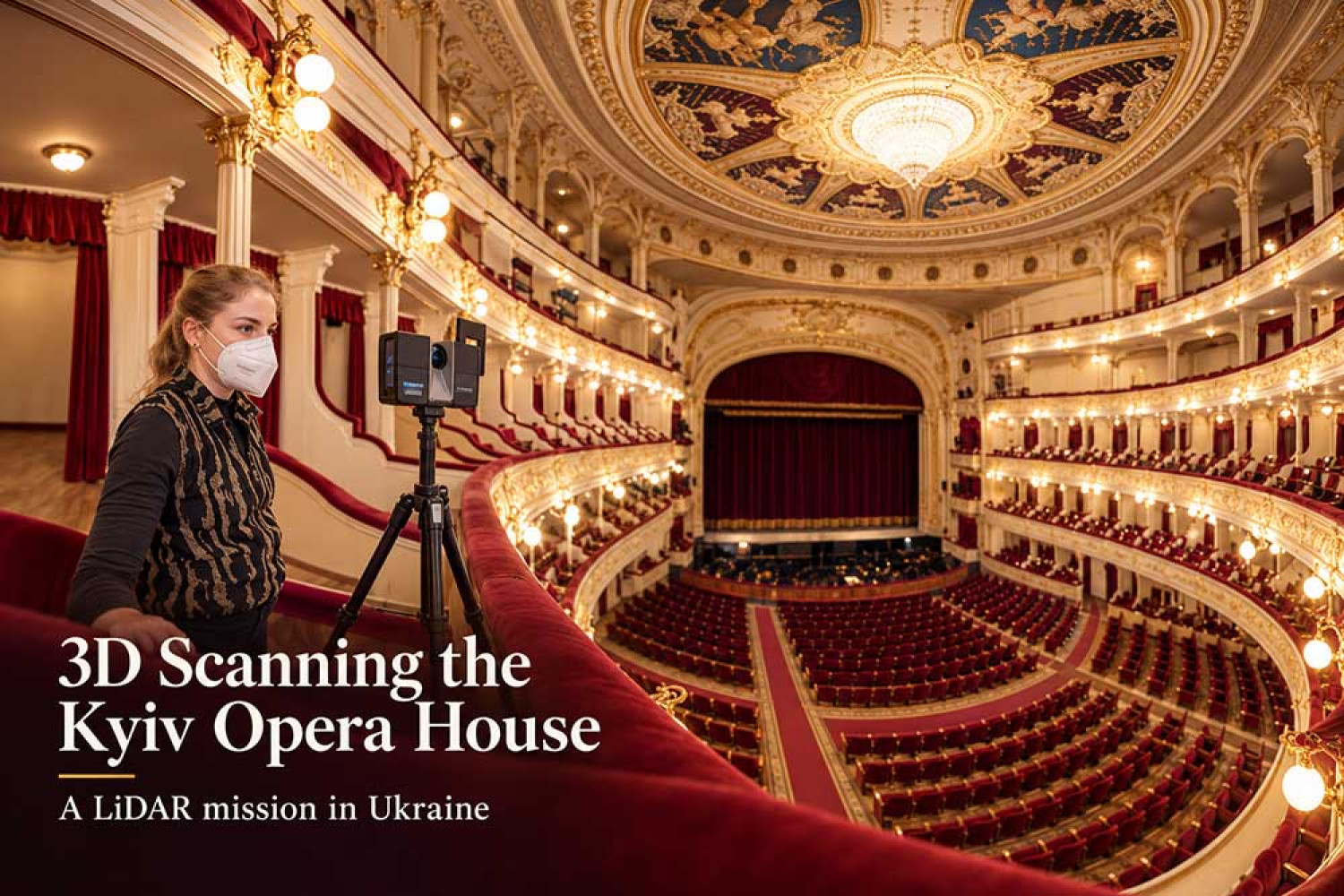
3D Scanning the Kyiv Opera House for Coca-Cola: A Remarkable LiDAR Mission
Behind the scenes of a 2021 3D scanning project at Ukraine’s National Opera House for “The Conductor – A Kind of Magic,” Coca-Cola’s global Coke Studio campaign.
3D scanning the National Opera House in Kyiv, Ukraine, was one of the most memorable international assignments of my career. In 2021, during the COVID-19 pandemic, I travelled to Ukraine to participate in a technically demanding LiDAR scanning mission for a major Coca-Cola commercial.
Our challenge was to capture the architecture of this historic building in just one day, using a FARO Focus S 3D laser scanner, and provide the geometric data needed for digital post-production.
The commercial would later become “The Conductor – A Kind of Magic,” part of the global launch of Coke Studio in 2022.
At the time, it was an exciting professional challenge. Just a few months later, Russia’s full-scale invasion of Ukraine would give the experience an entirely different meaning.
A 3D Scanning Mission in Kyiv During the Coronavirus Pandemic
It all began with a call from a colleague at Monark, a Paris-based 3D scanning company.
They were looking for an experienced professional to help capture a large, architecturally complex location using a laser scanner.
The destination: the National Opera of Ukraine, in Kyiv.
The project: an international Coca-Cola production involving music, filmmaking and visual effects.
International travel was still complicated by COVID-19 restrictions, changing regulations and uncertainty. Nevertheless, this was an opportunity I didn’t want to miss.
Beyond the technical challenge, visiting Ukraine held a deeply personal significance for me.
3D Scanning the Kyiv Opera House in Just One Day
Together with the French team from Monark, including Jérôme Battistelli and Johan Giner, I arrived in Kyiv facing an exceptionally tight schedule.
We had only one day to scan the Opera House.
The building was impressive, with magnificent chandeliers, ornate balconies, elaborate ceilings and architectural details reflecting generations of cultural history.
Our job was to capture the geometry of this environment as precisely and efficiently as possible while the film production team carried out its activities nearby.
Using the FARO Focus S 3D Laser Scanner
For this assignment, we used a FARO Focus S laser scanner, a professional device designed to measure and document complex physical environments.
Unlike a conventional camera, a LiDAR scanner measures distances between the device and surrounding surfaces using laser technology.
Millions of individual measurements form a 3D point cloud, a digital representation of an environment’s spatial geometry.
The benefits of professional 3D scanning include:
- Accurate capture of architectural geometry and interior spaces.
- Documentation of complex structural details.
- Creation of spatial references for digital reconstruction.
- Integration into visual effects and virtual production workflows.
- Preservation of geometric records of buildings at specific moments in time.
The main challenge was determining where to position the scanner, how to capture interconnected spaces and how to minimize hidden areas without exceeding our limited schedule.
We worked intensively throughout the day, coordinating with the production team.
By the end of the assignment, we had completed the on-site scanning.
However, capturing the data was only the first stage.
3D Scanning Post-Production: Jérôme Battistelli and Christophe Hustache Marmon
Once a laser scanning mission is completed, the raw data needs to be processed, organized and prepared for its intended application.
3D scan post-production is essential for transforming captured measurements into usable digital assets.
For this project, I especially want to recognize the excellent work of Jérôme Battistelli and Christophe Hustache Marmon.
Jérôme played a particularly important role in the post-production of the Opera House scanning data, working alongside Christophe, who also contributed to the processing work.
Their expertise was crucial in preparing the scans for the production’s digital workflow.
Depending on the requirements of a project, this type of work may involve registering individual scans, aligning and consolidating point clouds, cleaning unwanted data and preparing geometric information for visual effects teams.
The project demonstrates the importance of collaboration between on-location 3D capture specialists and dedicated post-production professionals.
Accurate scanning is only one part of a successful digital reconstruction process.
From Monark to Armada Studios
At the time of our Kyiv assignment, we collaborated on the project through Monark.
Today, Jérôme and Christophe continue working together as co-founders of Armada Studios, a Paris-based studio specializing in LiDAR scanning, photogrammetry, digital twins and digital assets for the creative industries.
Jérôme is Co-founder and CEO, while Christophe is Co-founder and Digital Twin Supervisor.
Armada Studios also features Coca-Cola’s “The Conductor – A Kind of Magic” (2022) among its projects.
Their work spans cinema, advertising, immersive experiences and virtual environments.
A special thank-you to Jérôme and Christophe for their expertise, their 3D scanning post-production work and this memorable collaboration.
Discover their projects: Armada Studios.
From LiDAR Scanning to Coca-Cola’s Global Campaign: The Conductor
The 3D scanning data captured at the Opera House was part of an ambitious international advertising production.
The final film, “The Conductor – A Kind of Magic,” was released in 2022 as part of Coca-Cola’s global Coke Studio launch.
Developed by creative agency BETC, the campaign brought together seven international artists to reinterpret Queen’s iconic song, It’s a Kind of Magic.
Conducted by Nicolas Krauze at the National Opera of Kyiv, the performance featured Ari Lennox, Griff, Ekin Beril, Mariah Angeliq, Tems, Tesher and TRI.BE.
The film transformed the historic Opera House into a spectacular musical environment where artists from different countries perform together.
The production shows how real-world locations, digital environments and cinematic effects can contribute to a major international campaign.
The processing of our 3D scanning data by Jérôme and Christophe was a specialist contribution to the project, distinct from the overall visual effects post-production of the finished film.
Watch the campaign and discover its creative concept: BETC – Coca-Cola, The Conductor.
Watch the Film: The Conductor – A Kind of Magic | Coke Studio
Keep the official Coca-Cola video already embedded in your original article here.
Why This Trip to Ukraine Was Deeply Personal
Beyond the technology, the film production and the opportunity to work on a major international campaign, travelling to Kyiv held a much deeper significance.
Part of my family history is connected to this region of Eastern Europe.
My paternal grandfather fled pogroms targeting Jewish communities between the First and Second World Wars. His village was destroyed, forcing him to escape to Argentina, where he died before I was born.
On my mother’s side, my grandmother’s family were Ukrainian Jews who fled persecution and antisemitic violence before the First World War.
Many of my ancestors did not survive the violence that devastated Jewish communities across the region.
For me, visiting Kyiv was therefore much more than another international assignment.
It was also a chance to connect, however briefly, with a part of my family’s history.
Discovering Kyiv in 2021: A Vibrant and Welcoming City
When we arrived, the Ukrainian production team welcomed us warmly.
One detail I vividly remember is the name of the local production company: Shelter.
Looking back, that name carries an especially poignant meaning.
Despite the complications of travelling during the pandemic, Kyiv felt modern, energetic and full of life.
After our long day of 3D scanning, we had the opportunity to explore the city.
We discovered stylish bars, lively restaurants, music venues and an atmosphere that reminded me of Tel Aviv on a Saturday night.
It was exciting to experience such a dynamic city.
I remember the satisfaction of completing our assignment, enjoying an evening with colleagues and discovering a place connected to my family history.
None of us could have imagined what would happen just a few months later.
Kyiv Before Russia’s Full-Scale Invasion
On February 24, 2022, Russia launched its full-scale invasion of Ukraine.
Like millions of people around the world, I watched the news with horror as images of destruction, displacement and human suffering emerged.
Seeing Kyiv, a city I had so recently explored, become a target of war was heartbreaking.
These events also brought back memories of my family’s experiences of persecution, violence and exile.
I began to think differently about our 3D scanning mission at the Kyiv Opera House.
What had started as a technical assignment for a Coca-Cola commercial had unexpectedly acquired a broader historical significance.
We had captured detailed geometric information from an important cultural landmark before the full-scale invasion.
Our work had become a digital record of a particular moment in the building’s history.
October 2026 Update: The National Opera of Ukraine Continues to Perform
When I originally published this article in September 2022, I was uncertain about the condition of the Opera House we had scanned.
The National Opera of Ukraine continues its artistic activities in Kyiv despite the ongoing war.
This does not establish that every part of the building remains unchanged since our visit in 2021.
However, knowing that artists and audiences continue to gather in this historic institution adds a powerful emotional dimension to the experience.
Why 3D Scanning Matters for Cultural Heritage Preservation
3D scanning historic buildings is not limited to film production or commercial applications.
LiDAR and digital capture technologies can provide valuable documentation for architects, researchers, museums and heritage conservation organizations.
3D Scanning for Architectural Documentation
Detailed point clouds can preserve geometric information about a building’s structure, dimensions and architectural features.
Depending on the quality and completeness of the capture, these datasets can support architectural research, conservation planning and comparisons of a building’s condition over time.
LiDAR Scanning for Visual Effects and Film Production
Film and advertising productions use 3D scanning to reproduce real-world environments digitally.
The resulting geometric data can provide references for virtual sets, digital extensions and the integration of computer-generated elements with live-action footage.
The Coca-Cola project at the Kyiv Opera House illustrates the relationship between real-world capture and digital post-production.
Digital Twins and Immersive Experiences
LiDAR scanning and photogrammetry can also contribute to digital twins, interactive installations and virtual reality experiences.
By combining spatial data with high-resolution photography, 360° imagery and real-time 3D technologies, it becomes possible to recreate and explore physical environments in digital form.
These methods offer opportunities for education, tourism, museums and cultural exhibitions.
Documenting Cultural Heritage at Risk
In regions affected by war, natural disasters or major transformations, detailed digital records can become particularly valuable.
A point cloud cannot replace a monument, its history or the communities connected to it.
However, accurate 3D documentation can help preserve knowledge of architectural features and support future research or conservation efforts.
This is one of the most meaningful reflections I take away from our assignment in Ukraine.
An Extraordinary 3D Scanning Project That Became Something More
When we left Kyiv in 2021, we believed we had completed a memorable technical assignment.
We had scanned an extraordinary historic building, contributed to a major international Coca-Cola production and met wonderful people.
I could never have imagined how quickly the world around that experience would change.
Today, this project means far more to me than a successful 3D scanning mission.
It represents the intersection of technology, international collaboration, filmmaking, cultural heritage and personal history.
It also reminds me that beyond their commercial applications, digital capture technologies can help document the places and stories that shape our collective memory.


Project Credits and Acknowledgments
Project: Coca-Cola — The Conductor, A Kind of Magic (Coke Studio, 2022)
Brand: Coca-Cola
Creative agency: BETC
Film production: Iconoclast
Direction: We Are From LA
Local production in Ukraine: shelter.film
Film VFX post-production: Mathematic Paris
National Opera of Ukraine — 3D Scanning Team
- Michael Kolchesky — Visual Solutions 360: On-site 3D capture and LiDAR scanning.
- Jérôme Battistelli: Technical collaboration and major contribution to 3D scan data post-production.
- Christophe Hustache Marmon: 3D scan data post-production.
- Shelter.film : on site production
- Johan Giner: On-site 3D scanning team.
Project collaboration at the time: Monark
Jérôme and Christophe’s current company: Armada Studios
My sincere thanks to everyone involved, particularly our French and Ukrainian colleagues, for their expertise, professionalism and hospitality.