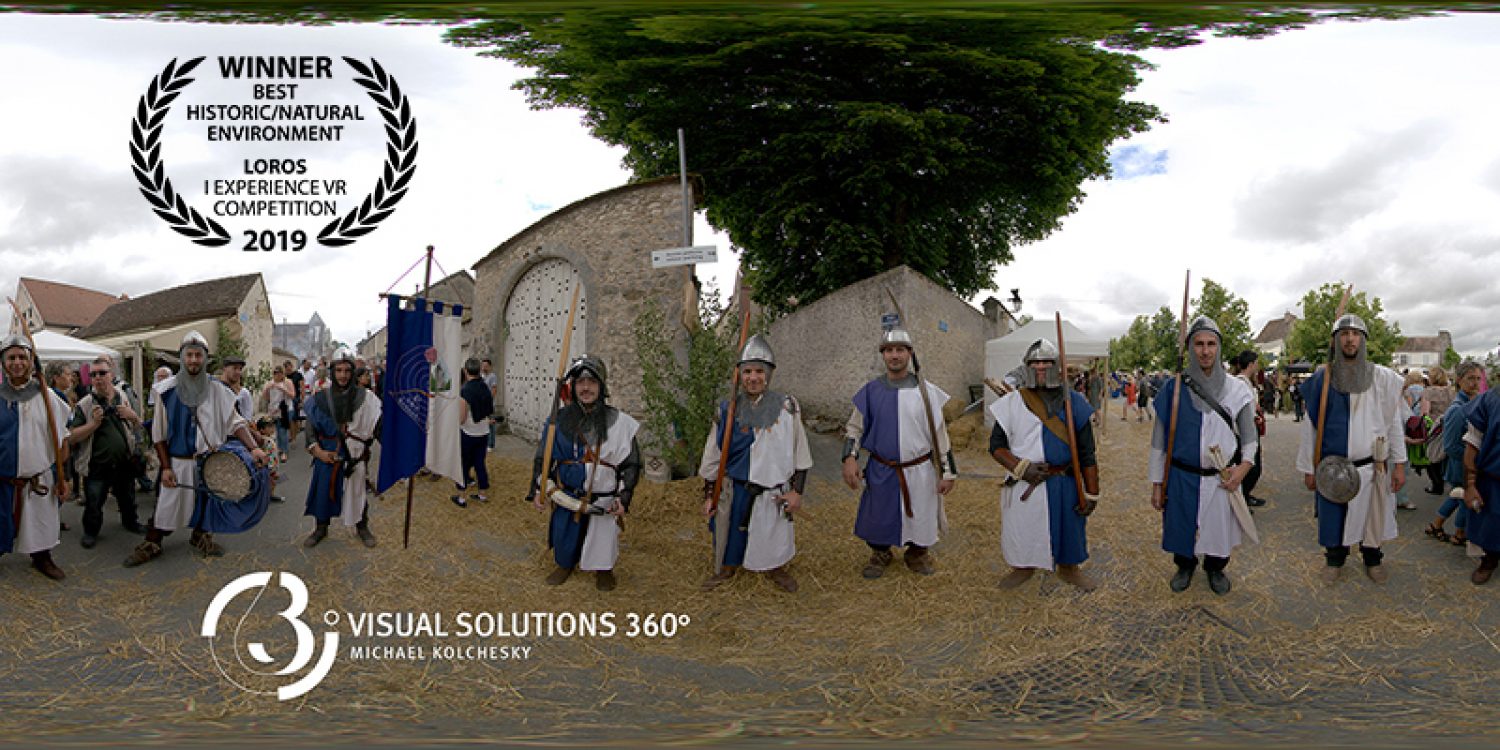

In 2019, Michaël Kolchesky of Visual Solutions 360 won the LOROS VR film award in the Historic/National Trust category of the VR for Good competition with “Back to the Past – Medieval Festival of Provins.”
What began as a personal 360° filming project in 2017 became an award-winning immersive experience, highlighting how virtual reality can make cultural events accessible to people unable to experience them in person.
But what made this recognition particularly meaningful was the purpose behind the competition: using virtual reality to bring experiences, memories and moments of escape to people receiving hospice care.
Back to the Past: Filming the Medieval Festival of Provins in 360°
Located in Seine-et-Marne, approximately 90 kilometres from Paris, Provins is a UNESCO World Heritage Site, recognised for its exceptionally preserved medieval architecture and its historical importance as a centre of European trade.
During the annual Medieval Festival, the town comes alive with costumes, musicians, street performances, artisans and visitors celebrating medieval traditions.
It’s the kind of event where something interesting is happening in every direction, making it a particularly enjoyable environment for 360° filming.
Unlike traditional video, where the filmmaker chooses exactly what the audience sees, 360° video lets viewers explore the surroundings for themselves.
Look left, and you might discover a performer. Turn around, and you can observe the crowd. Look up, and you can appreciate the medieval architecture surrounding the festivities.
For me, that freedom to explore is one of the most interesting aspects of immersive filmmaking.
The film was created in 2017, without a commercial brief or a client. It was simply an opportunity to document a lively cultural event using 360° technology.
Discover the Medieval Festival of Provins – Official Website
Learn more about Provins – UNESCO World Heritage Centre
LOROS VR Film Award 2019: Historic/National Trust Category Winner
In 2019, Visual Solutions 360 was named the winner of the Historic/National Trust category in the international LOROS I Experience VR filmmaking competition.
Organised by LOROS Hospice, a UK charity based in Leicester, the competition attracted 100 entries from VR filmmakers, with six filmmakers receiving prizes across different categories.
The film “Medieval Festival of Provins”, directed and produced by Michaël Kolchesky, received the £1,000 category prize.
The competition was developed in collaboration with immersive production studio CATS are not PEAS, as part of LOROS’s wider commitment to exploring the potential of virtual reality in hospice care.
Read the 2019 award winners announcement – DLUXE Magazine
LOROS Hospice and I Experience VR: Virtual Reality with a Purpose
What made the LOROS competition different from many other VR film awards was its objective.
The project wasn’t simply looking for impressive immersive films.
LOROS Hospice developed I Experience VR, an initiative using 360° experiences to offer moments of relaxation, distraction and exploration to people whose illness or reduced mobility might prevent them from travelling or participating in everyday activities.
Imagine being unable to travel, visit a favourite place or attend an outdoor festival.
A VR headset cannot replace those experiences, but it can offer an opportunity to reconnect with the outside world, explore unfamiliar places or revisit familiar surroundings.
Through the I Experience VR initiative, LOROS sought to make these experiences available to patients and their families, including people confined to beds or chairs.
The competition invited filmmakers to contribute immersive content suitable for this purpose, from nature and landscapes to music, cultural experiences and historical locations.
For a personal film originally made during a visit to Provins, becoming part of an initiative with such a human objective gave the project a completely different meaning.
Discover the I Experience VR project – LOROS Hospice
Why 360° Video Matters for Cultural Heritage and Accessibility
Virtual reality is often associated with gaming, entertainment and advanced technology.
But one of its most interesting applications is much simpler: allowing people to experience places and events they cannot physically access.
For cultural heritage, 360° video can document a particular moment in time, preserving the atmosphere of a location or event.
For museums and historical sites, immersive video can complement exhibitions and educational material by providing visitors with a different perspective.
And for people with limited mobility, such experiences can provide access to places and activities that might otherwise remain out of reach.
Of course, a 360° video isn’t the same as physically being somewhere, and its benefits depend on the individual viewer.
But projects such as LOROS’s I Experience VR demonstrate how immersive technology can serve a purpose beyond entertainment.
That is what made this particular award meaningful to me.
Watch the Award-Winning Medieval Festival of Provins 360° Film
Experience the atmosphere of the 2017 Medieval Festival of Provins through the original 360° film.
Explore the historic town, follow the performances and discover the celebrations from your own point of view.
▶ Watch “Back to the Past – Medieval Festival of Provins” on DeoVR
For the most immersive experience, watch the film using a compatible VR headset. You can also explore the 360° video directly on a computer or mobile device.
Film credits
- Title: Back to the Past – Medieval Festival of Provins
- 360° filming and production: Michaël Kolchesky – Visual Solutions 360
- Location: Provins, Seine-et-Marne, France
- Filming year: 2017
- Award: LOROS VR for Good, Historic/National Trust Category Winner, 2019
From a Personal 360° Film to Immersive Storytelling for Good
Looking back, what I appreciate most about this project is that it started as a simple personal experiment.
There was no large production team or elaborate setup. I wanted to capture a fascinating event in a way that allowed people to look around and experience its atmosphere.
Nearly a decade later, 360° cameras, image quality and VR headsets have evolved considerably. But the fundamental idea remains the same.
Immersive filmmaking is not only about resolution, technical specifications or the latest headset.
Sometimes, it’s about giving someone the opportunity to be somewhere they otherwise couldn’t.
And occasionally, a small personal project can find a purpose far beyond what was originally imagined.
Michaël Kolchesky
360° Filmmaker, VR Production & Immersive Content Specialist
Visual Solutions 360
References and further reading